
David Joyner, President of US Bullion Reserve.
You're thinking about moving retirement money into physical metal, and now a dealer is pushing rare coins. That pitch deserves scrutiny. When you are choosing between bullion and numismatic coins for a Gold IRA, it is not a matter of personal preference.
The IRS decides whether your holding is a qualified asset or a taxable distribution, and one wrong pick can unravel your tax shelter. The risk grows as your allocation grows.
If you move $250,000 from a self-directed IRA into collectible coins, you could owe tax on the entire amount, plus a 10% early withdrawal penalty if you are under 59 1/2. Premiums are not trivial either. Collector premiums can run far higher than bullion, often 40% to 200% above metal value, while qualifying bullion can carry wholesale premiums as low as 3% above dealer cost.
Keep reading to get the actual eligibility rules, which coins and bars qualify, why numismatic coins do not work in a Gold IRA, and what to confirm before you fund. This guide will help you decide which physical format fits your retirement savings and which ones do not.
The Fundamental Difference Between Metal Value and Collector Value
Bullion gets its price from its metal content. Numismatic coins get their value from scarcity and condition. That split drives everything else: eligibility, pricing, and risk. A one-ounce gold coin still holds one ounce of gold, whether it was minted in 1986 or last year.
The metal content is identical. What changes is the premium the market pays for the coin's story: bullion buyers disregard that story, while collectors pay a substantial premium for it. This is not just marketing.
The mint defines these categories this way, and the IRS uses the same line to decide what a retirement account can hold.
How Bullion Coins Derive Value From Weight and Spot Price
Bullion coins trade based on weight and purity. According to the U.S. Mint's definition of bullion coins, these coins are valued by their weight and the fineness of a specific precious metal.
Price starts with the gold spot price, quoted per troy ounce. Dealers add a premium to cover fabrication, distribution, and margin. Nothing more. If the spot moves, your coin's value moves with it.
Wholesale desks quote in tiers, not flat markups. Live spot pricing, updating every 15 seconds, keeps pricing verifiable. If you are buying $50,000 or more, premiums can start at 5% above dealer cost. Gold bars work the same way, usually at even lower premiums.
How Numismatic Coins Derive Value From Rarity and Demand
Numismatic coins add another layer of value beyond gold content. Collector demand depends on mintage, survival rates, historical significance, and graded condition. Two coins with the same metal content can trade for thousands of dollars apart.
That is the numismatic premium, and it is set by collectors, not the commodity market. The Commodity Futures Trading Commission (CFTC) has noted that these collector premiums can run 40% to 200% above a coin's metal value. The collector market is thinner, more subjective, and slow to clear large lots.
Rare coins can perform well for experienced collectors over decades. Still, they are a different asset class from gold bullion, with different pricing and different buyers.
Why Premiums and Resale Markets Differ
Resale highlights the gap. Bullion coins and bars are quoted against a published spot price, so you can get a bid quickly.
Selling collectible coins is different. You need an appraisal, a grade, and a buyer who wants that specific coin. The numismatic premium you paid may not come back when you sell. That is a real risk, especially in a retirement account with strict timelines.
Here is a side-by-side of the factors that matter:
Price basis: Bullion coins and bars are priced off the gold spot price per troy ounce, while numismatic and rare coins are priced on rarity, grade, and collector demand.
Typical premium: Bullion runs about 3% to 5% above dealer cost at volume, whereas numismatic coins often carry 40% to 200% above melt.
Price transparency: Bullion prices are published and updated every 15 seconds, while numismatic prices are negotiated and depend on appraisal.
Resale speed: Same-day bids are common for bullion, but numismatic coins can take days to weeks and depend on finding the right buyer.
Gold IRA eligibility: Bullion qualifies if it meets fineness standards, while numismatic and rare coins are generally prohibited as collectibles.
Those eligibility rules come straight from the tax code. It is worth understanding why.
IRS Rules That Determine What an IRA May Hold
Internal Revenue Code (IRC) Section 408(m) sets the rules. It bars IRAs from holding collectibles, then makes narrow exceptions for certain bullion and coins.
Anything outside those exceptions gets treated as distributed the moment your account buys it. There is no warning and no grace period. Taxes hit right away.
The Government Accountability Office pointed out that IRS Publications 590-A and 590-B do not give much detail on unconventional IRA assets, including storage. That is where some questionable product pitches sneak in.
How IRC Section 408(m) Treats Collectibles
Section 408(m) lists artwork, rugs, antiques, gems, stamps, alcoholic beverages, and most metals and coins as collectibles. If your IRA buys one, you are taxed on that amount that year. IRC 408(m)(3) carves out the exception.
Certain U.S. government coins qualify, as does bullion meeting the required fineness for exchange-traded contracts, but only if a trustee holds it. The word "trustee" matters. The bullion has to be in the physical possession of an IRS-approved trustee or custodian, not in your safe.
Minimum Fineness Requirements for Qualifying Bullion
Fineness is the first hurdle. IRA-eligible bullion must meet these minimum purity levels:
Gold: .995 fine (99.5% pure), though the American Gold Eagle is allowed at .9167 by law
Silver: .999 fine (99.9% pure)
Platinum: .9995 fine (99.95% pure)
Palladium: .9995 fine (99.95% pure)
Metal must also come from an approved mint, refiner, or assayer. A .9999 bar from an unrecognized shop still does not qualify.
High purity is not enough. If a coin is sold at a collector premium because of its grade, it can still be treated as a collectible.
Custody and Depository Requirements for Physical Metals
A gold IRA custodian holds the title, files the paperwork, and sends metal to an IRS-approved depository. You pick the products. You do not take possession.
Storing gold in a home safe, a safe deposit box, or using a checkbook IRA structure has triggered IRS challenges. That can mean a taxable distribution plus the 10% penalty if you are under 59 1/2.
Depositories usually offer segregated storage, where your metal is kept separate and labeled for your account, or commingled storage at a lower fee. Once custody is sorted, the next step is figuring out which coins and bars actually qualify.
IRA-Eligible Bullion Coins, Bars, and Limited Proof Exceptions
Qualifying products fall into three buckets: government-minted bullion coins, bars from accredited refiners, and a short list of proof coins. Everything else needs extra verification. Approved product lists can vary by custodian, since each one has its own compliance review on top of the tax code. Double-check the product with your custodian before moving funds.
Recognized Government-Minted Gold and Silver Coins
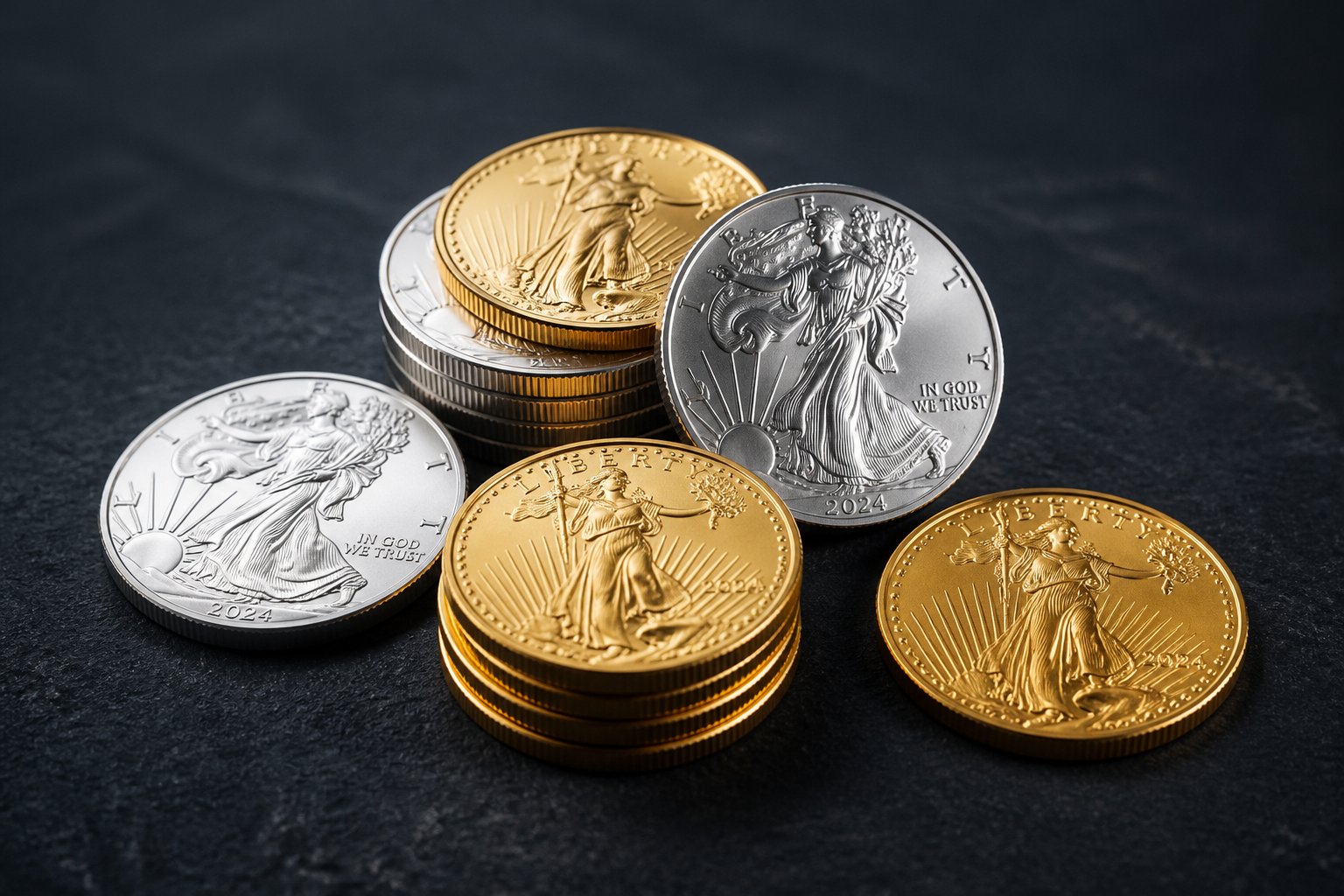
The most accepted coins for gold IRAs are:
American Gold Eagle, allowed at .9167 fineness by law
American Gold Buffalo, .9999 fine, from the U.S. Mint
Canadian Gold Maple Leaf, .9999 fine
Austrian Gold Philharmonic, .9999 fine
American Silver Eagle and Canadian Silver Maple Leaf, .999 fine
American Platinum Eagle and American Palladium Eagle, .9995 fine
Custodians typically approve these IRA gold bullion coins with no extra hassle. Dealers worldwide quote them against spot, so liquidity is strong.
Sovereign coins also come with a government guarantee of weight and purity, which makes selling simpler.
Approved Bars and Refiner Standards
Bars must come from a refiner accredited by a recognized body. Usually, that means a London Bullion Market Association (LBMA) good delivery refiner, or a mint, refiner, or assayer approved for New York Mercantile Exchange (NYMEX) or Commodity Exchange (COMEX) contracts.
Names like PAMP Suisse and Valcambi are on those lists, along with national mints. Each bar should have a serial number, weight, fineness stamp, and refiner hallmark. Bars tend to cost less per ounce than coins because fabrication is cheaper. On a big allocation at a 3% premium, that price difference adds up.
When Proof Coins May Qualify and When They Do Not
Some proof coins make the cut. The American Gold Buffalo proof and proof American Eagles from the U.S. Mint are usually accepted if they are in the original mint packaging with the certificate of authenticity.
They do not qualify when the focus shifts from metal to grade. If a proof coin is sold at a steep markup for a third-party grade, a rare mint mark, or low mintage, it is being sold as a collectible.
The premium tells the story. A proof at a modest premium over spot is just bullion with a fancy finish. A proof at a big multiple of spot is a numismatic play, and that is where most IRA compliance issues start.
Why Most Numismatic and Collectible Coins Do Not Belong in a Gold IRA
There are two main reasons: the collectibles prohibition and premiums that do not follow the gold price. The first is a legal issue. The second is economic, and it matters even outside retirement accounts.
Bullion-focused precious metals dealers usually keep the categories separate. Numismatic coins get their value from condition, vintage, rarity, and collectability, and are usually sold by coin dealers rather than bullion dealers.
That separation exists for good reason. Each product serves different buyers and has different resale paths.
The Collectibles Prohibition and Deemed Distribution Risk
If your self-directed IRA buys a coin that does not fit the 408(m)(3) exception, the purchase is treated as a distribution that year. Traditional IRA distributions get taxed as ordinary income.
If you are under 59 1/2, add the 10% early withdrawal penalty. A $100,000 coin purchase could saddle you with a five-figure tax bill in one year. The metal is still yours, but the tax shelter is gone. Since the account, not the dealer, takes the hit, you need to verify the product before wiring funds.
Pre-1933 U.S. Gold Coins, Grading, and Collector Premiums
Pre-1933 U.S. gold coins are a common sales pitch. Saint-Gaudens Double Eagles and Liberty Head Eagles really do contain gold, and some have historical appeal. They do not meet the fineness or category requirements.
Their gold content is about .900 fine, below the .995 standard, and they are priced as collectibles based on grade, date, and mint mark. These coins belong in a taxable collection, not a retirement account.
How to Evaluate a Coin Marketed as Semi-Numismatic
"Semi-numismatic" is just a sales term. If you hear it, check these four things:
Fineness: Is the coin .995 gold, or is it a statutory exception like the American Gold Eagle?
Issuer: Was it made by a government mint or an accredited refiner on the approved list?
Premium: Is the price a single-digit percentage over spot, or well above melt value?
Custodian sign-off: Will your custodian confirm in writing that they will accept this product?
If you cannot answer any of these, the product does not belong in your account.
Choosing the Right Format for a Retirement Allocation
For retirement, the goal is simple: get exposure to gold at the lowest reasonable premium. Standard bullion coins and bars from recognized issuers do the job.
Physical gold behaves differently from stocks or real estate. That is the whole point of holding it. Paying a collector premium just adds a variable that has nothing to do with the gold price.
Whether you use a traditional IRA or a Roth IRA, the tax treatment changes, but the eligibility rules do not. Both follow the same 408(m) standard.
Prioritizing Transparent Gold Price Exposure
Transparent pricing lets you check your cost against a public number. Spot price plus a clear premium does exactly that. When you get a collector quote, you cannot compare it as easily.
Independent guidance points the same way. Forbes reviewed precious metal IRAs and explained that the IRS blocks IRAs from holding rare or collectible coins. It recommends comparing dealer spreads rather than accepting whatever markup you are quoted.
Volume-based pricing tiers make those comparisons simple. If you invest $50,000 to $250,000, the premium is 5%. From $250,001 to $500,000, it is 4%. For allocations above $500,001, it drops to 3% above dealer cost.
Balancing Bar Efficiency With Coin Liquidity
Bars usually offer the lowest premium per ounce, especially in kilo and 10-ounce sizes. Coins, on the other hand, give you flexibility since you can sell one ounce at a time.
That flexibility really matters for required minimum distributions (RMDs). Traditional IRA owners have to start distributions at age 73, and you cannot just cut a bar to hit an exact number.
A lot of people pair bigger bars for cost savings with a few one-ounce coins to cover expected RMDs. Your custodian can confirm which products qualify for in-kind distribution.
Questions to Confirm Before Funding a Self-Directed IRA
Before you send money, get written answers to a few key questions: Which products does the custodian approve? Which depository will hold them? Is storage segregated or commingled? What is the total annual fee?
Ask how the dealer locks in your price. Usually, pricing gets locked after funds are received. Some repeat clients might get a price lock before funding, depending on account history. Written documentation makes these answers stick if there is ever a disagreement.
Confirm Eligibility and Pricing Before You Fund
Two documents solve most issues: written custodian approval for the exact products and a written quote showing spot price plus premium. Always get both before sending funds.
A self-directed gold IRA involves three parties: you, the custodian, and the dealer. Everyone needs to agree on the same product list.
Documenting Product Eligibility, Custody, and Storage
Ask your custodian for written confirmation naming the specific coins and bars, including their fineness. A vague statement like "gold is allowed" is not enough.
Confirm the IRS-approved depository by name and location. Check the storage type and insurance coverage. Request a sample account statement so you will know how holdings are reported.
Keep your purchase invoice, depository receipt, and custodian confirmation in one file. If eligibility is ever questioned, you will have your record ready.
Using Specialist Guidance for Qualifying Allocations
A gold IRA rollover has a lot of moving parts: custodian paperwork, funding, and product selection. A dedicated specialist can keep those steps in order, so you do not have to juggle everything.
At US Bullion Reserve, specialists support IRA rollovers from setup through delivery. Wholesale pricing tiers start at $50,000, with premiums as low as 3% above dealer cost on orders over $500,001. Most orders ship fully insured within 48 hours once funds clear, and pricing is locked.
Call 1.855.655.4653 to discuss IRA rollover options and confirm which products qualify for your self-directed account.
Frequently Asked Questions
What Is the Difference Between Bullion Coins and Numismatic Coins?
Bullion coins are priced by weight and fineness, tracking the gold spot price. A one-ounce coin equals one ounce of metal. Numismatic coins get priced based on rarity, grade, and collector demand, so they carry a premium that has nothing to do with metal content. The collector market sets that premium, not the commodity market.
Can Numismatic Coins Be Held in a Gold Individual Retirement Account (IRA)?
Usually, no. IRC Section 408(m) treats rare and collectible coins as prohibited collectibles. Buying them triggers a taxable distribution for that year. If you are under age 59 1/2, you might also face a 10% early withdrawal penalty on top of regular income tax.
Which Gold Coins Are Eligible for a Self-Directed Gold IRA?
The American Gold Eagle, American Gold Buffalo, Canadian Gold Maple Leaf, and Austrian Gold Philharmonic are all widely accepted. Gold bars from LBMA, NYMEX, or COMEX-approved refiners at .995 fineness or higher qualify too. Always confirm the exact product with your custodian in writing before funding.
Why Do Numismatic Coins Often Carry Higher Premiums Than Bullion Coins?
Their value comes from scarcity, condition, mint mark, and grading. That means you need an appraisal and a specific buyer. The market is thinner, so premiums can range from 40% to 200% over melt value. Bullion premiums at volume are usually much lower, from 5% down to 3% above dealer cost.
Are Bullion Coins or Numismatic Coins Better for Long-Term Gold Investment?
For retirement accounts, bullion is the practical pick. It is IRA-eligible, priced transparently, and easy to liquidate. Numismatic coins might suit a savvy collector, but usually outside a retirement plan. The right choice depends on whether you want gold price exposure or to play the collector market.
How Are Bullion and Numismatic Coins Valued When Sold From a Gold IRA?
Bullion gets valued against the live spot price, so you can usually get a bid the same day. Collectible coins need an appraisal and a grade, and the numismatic premium might not come back in full. That valuation gap is why custodians prefer standard bullion for in-kind distributions and RMDs.
Getting the Product Right Before the Wire Clears
The eligibility question is really about one thing: Is the coin priced for its metal or for its story? Metal-priced bullion from a government mint or accredited refiner clears IRC Section 408(m). Story-priced numismatic coins do not. If you get that wrong, you could owe tax on the full purchase plus a possible 10% penalty.
Once you settle eligibility, the premium is the lever you control. Volume pricing tiers at 5%, 4%, and 3% above dealer cost apply to standard bullion, not collector inventory. That is why format and pricing decisions go hand in hand.
If you are preparing a rollover or direct allocation, a quick call with a specialist can confirm product eligibility, custodian requirements, and current wholesale pricing for your allocation size before you send any funds. Talk with a specialist to review current wholesale pricing for orders of $50,000 or more.
This content is for educational purposes only and is not investment, tax, or legal advice. Consult a licensed financial advisor before making investment decisions.